
Basketball is one of the most popular sports in the modern world, played and watched by millions across continents. From crowded urban courts to massive professional arenas, the game has become a global cultural force. But behind its worldwide success lies a surprisingly simple origin story.
Basketball was invented in 1891 by James Naismith, a Canadian physical education instructor working at the International YMCA Training School in Springfield. What began as a small indoor activity to keep students active during winter would soon transform into a global phenomenon.
The Historical Context: Why Basketball Was Invented
To understand basketball’s invention, we must first understand the problem it was designed to solve.
In the late 19th century, physical education was becoming an important part of academic life in North America. However, most popular sports at the time—such as football and rugby—were:
- too rough,
- required large outdoor fields,
- and were difficult to play during harsh winters.
During the winter of 1891, Naismith was given a challenging assignment:
create a new indoor game that was safe, engaging, and easy to play in a confined space.
He had only 14 days to come up with a solution.
The Birth of Basketball (1891)
Naismith approached the challenge with careful thought. Instead of creating a completely new concept, he combined elements from existing games:
- A ball similar to soccer,
- A target-based scoring system,
- And rules that minimized physical contact.
He then introduced a simple yet revolutionary idea:
players would throw a ball into a raised goal instead of running with it.
The First Setup
The original basketball game looked very different from today:
- Two peach baskets were used as goals.
- They were nailed to a balcony about 10 feet high (the same height still used today).
- A soccer ball was used.
- There were 9 players on each team.
After every successful shot, someone had to climb up and retrieve the ball from the basket.
The 13 Original Rules of Basketball
One of Naismith’s greatest contributions was not just the idea of the game, but the structure he gave it.
He wrote 13 basic rules, which emphasized:
- skill over strength,
- teamwork over individual aggression,
- and strategy over chaos.
Some key rules included:
- Players could not run with the ball (no dribbling initially).
- The ball had to be passed from player to player.
- Physical contact like pushing or striking was strictly forbidden.
- A goal was scored when the ball stayed inside the basket.
These rules created a non-violent, skill-based sport, which was very different from other games of that era.
Why the Game Was Called “Basketball”

The name came directly from the equipment used:
- Basket (the peach baskets used as goals)
- Ball (the soccer ball used to play)
Initially written as “basket ball,” it later evolved into the single word we use today: basketball.
Early Growth and Rapid Spread
Basketball spread incredibly fast, and this was no coincidence.
Key Reasons for Its Popularity
- Easy to Learn
The basic concept was simple and could be understood quickly. - Minimal Equipment
All that was needed was a ball and two goals. - Indoor Play
It solved the major problem of winter inactivity. - YMCA Network
Through the YMCA, the game spread rapidly across the United States and internationally.
Within just a few years, basketball was being played in:
- schools,
- colleges,
- community centers,
- and even internationally.
Evolution of the Game
Over time, basketball underwent significant changes that shaped the modern sport.
Major Developments
- Dribbling Introduced
Players were later allowed to bounce the ball while moving. - Open Nets Replaced Peach Baskets
This eliminated the need to manually retrieve the ball. - Standardized Team Sizes
Teams were reduced from 9 players to 5 players. - Professional Leagues Formed
Leading eventually to organizations like the National Basketball Association. - Three-Point Line Added
Revolutionizing scoring strategies. - Shot Clock Introduced
Making the game faster and more exciting.
Basketball Becomes a Global Sport
Basketball quickly expanded beyond the United States.
Today, it is governed internationally by organizations like FIBA and is played professionally in almost every country.
It is also a major part of the Olympic Games, where nations compete for global recognition.
Countries like:
- the United States,
- Spain,
- China,
- the Philippines,
- and India
have growing basketball cultures and fan bases.
Cultural and Social Impact
Basketball is more than just a sport—it is a cultural movement.
It has influenced:
- Music (especially hip-hop culture),
- Fashion (sneakers, jerseys),
- Media and entertainment,
- And global youth identity.
Icons of the game have become worldwide celebrities, inspiring millions.
Basketball courts are often seen as:
- places of community,
- symbols of opportunity,
- and platforms for social expression.
Why Naismith’s Invention Was So Unique
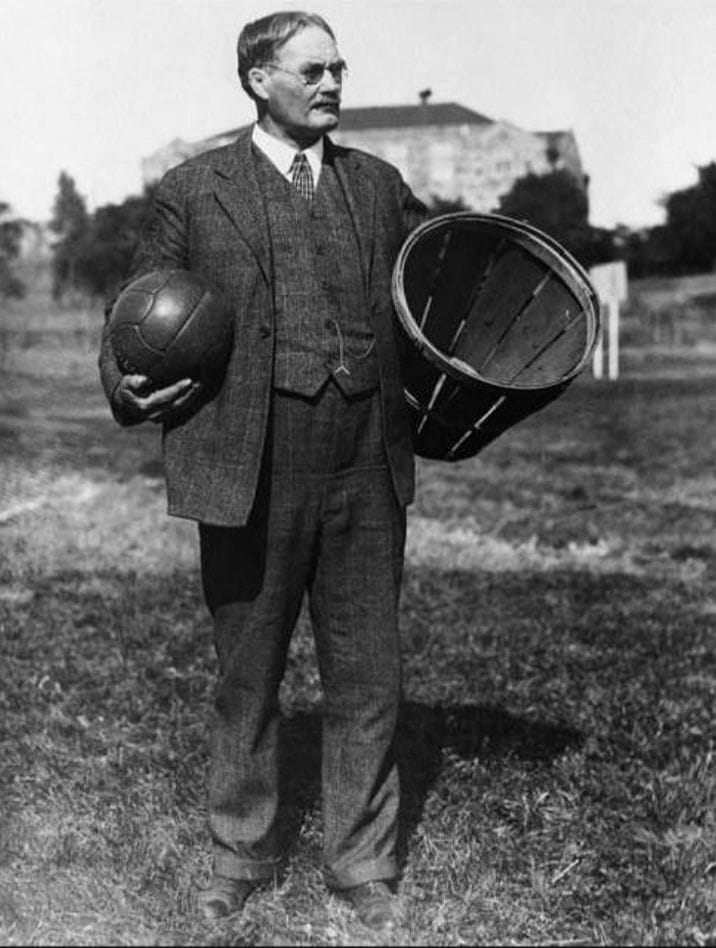
Unlike many sports that evolved over centuries, basketball was:
- invented by a single person,
- at a specific time,
- with a clear purpose.
Naismith’s genius was in creating a game that was:
- simple,
- flexible,
- scalable,
- and engaging.
He didn’t just invent a sport—he created a system that could evolve with time.
Final Analysis: The Legacy of Basketball
So, who invented basketball?
The answer is clear: James Naismith in 1891.
But the real story is deeper than that.
Basketball represents:
- innovation born from necessity,
- simplicity turned into global impact,
- and a perfect balance of physical skill and mental strategy.
From a small gym in Springfield to massive arenas worldwide, basketball has become one of humanity’s most influential sporting inventions.
Its journey proves that even the simplest ideas, when designed thoughtfully, can change the world.
Related : https://tinselisland.com/pathetic-nba-eye-injuries-cost-2-4m-in-one-year/
